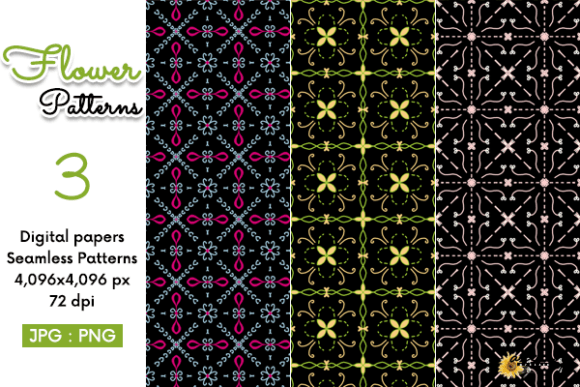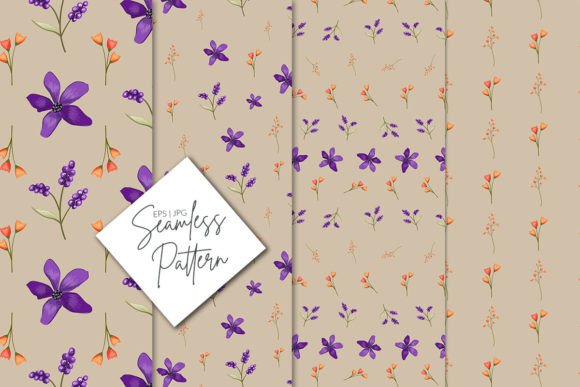
Flower Seamless Patterns Vol.37: A Versatile Resource for Designers, Educators, and Makers
Seamless pattern design remains a cornerstone of visual communication—its quiet efficiency enabling repetition without visual interruption, its organic rhythm supporting both subtlety and impact. Among contemporary digital pattern libraries, Flower Seamless Patterns Vol.37 stands out not for novelty alone, but for its thoughtful balance of botanical authenticity and functional adaptability. This collection doesn’t merely replicate floral motifs; it distills the structural logic of nature—leaf venation, petal layering, stem curvature—into repeatable, scalable assets that behave predictably across media and scale.
What Makes These Patterns Structurally Sound?
At its core, a seamless pattern must resolve edge alignment flawlessly. Unlike tiled images with visible seams or forced symmetry, the files in Flower Seamless Patterns Vol.37 are engineered using vector-based construction (EPS 10) and high-fidelity raster output (3500 × 3500 px JPG). Each design undergoes manual tile testing—not just algorithmic tiling—to ensure continuity at all four borders. This means when applied to a large-format print or stretched across a social media banner, no “jump” occurs where edges meet. The EPS file retains full editability: color shifts, scaling, and component isolation remain lossless, supporting iterative refinement in Adobe Illustrator, Affinity Designer, or CorelDRAW.
The resolution—3500 × 3500 pixels—is calibrated for real-world use cases. It exceeds standard print requirements for A4–A3 documents (where 300 DPI yields ~3508 × 4961 px), accommodates retina-display web exports, and allows safe cropping for thumbnails or detail-focused close-ups. Importantly, this size avoids unnecessary bloat: smaller files load faster on websites, and larger ones often introduce pixelation when downscaled without proper interpolation.
Craft and Educational Settings
In classrooms and maker spaces, Flower Seamless Patterns Vol.37 serves as both material and teaching tool. Art educators use the patterns to demonstrate tessellation, repetition, and positive/negative space—concepts made tangible when students overlay transparencies or cut stencils from printed sheets. For tactile learners, the organic flow of stems and blossoms supports kinesthetic engagement: cutting around leaf outlines reinforces spatial reasoning, while arranging repeated elements builds early design literacy. Scrapbookers and cardmakers appreciate how the patterns scale cleanly to 4×6 inch photo prints or 5×7 inch greeting cards—no distortion, no awkward cropping, and no need for third-party resampling tools.
Professional Graphic Design and Branding
Brands seeking warmth without cliché increasingly turn to botanical motifs—not as literal illustrations, but as textural underlays that suggest growth, care, or natural integrity. A wellness startup might apply a muted variant of Flower Seamless Patterns Vol.37 as a subtle background behind service icons; an eco-conscious packaging firm may integrate the pattern into label linings or foil stamping templates. Because each design includes both vibrant and desaturated versions (achieved through editable vector layers), designers retain control over brand-aligned palettes without re-creating base geometry.
Social media banners benefit particularly from the aspect-ratio flexibility inherent in seamless tiling. Whether adapting to Instagram’s 1080×1350 feed dimensions or LinkedIn’s 1584×396 header, the pattern repeats uniformly—no stretching, no center-cropping artifacts. Designers report reduced revision cycles when clients request format adjustments, since the same source file functions across platforms.
Interior and Digital Environments
Wallpaper designers and interior stylists use these patterns as foundational layers—not just for physical wall coverings, but for virtual staging, AR room previews, and digital mood boards. The consistent 1:1 square ratio simplifies UV mapping in 3D software like Blender or SketchUp, and the absence of hard directional lines prevents visual fatigue in extended viewing contexts (e.g., Zoom backgrounds or kiosk interfaces). One architecture educator noted using the pattern as a neutral backdrop during student presentations: it conveys aesthetic intention without competing with content—a rare quality among decorative assets.
Practical Considerations for Real-World Use
While Flower Seamless Patterns Vol.37 delivers technical robustness, successful implementation depends on context-aware decisions. Color fidelity is one such factor: the note “colors on your screen may be slightly different from the actual print” reflects the unavoidable gap between RGB display profiles and CMYK or Pantone ink behavior. Designers preparing for physical output should soft-proof using calibrated monitors and request printer-specific ICC profiles—especially when matching brand colors. The EPS file allows precise spot-color assignment; the JPGs serve best for screen-based work or quick mockups.
Scaling behavior also warrants attention. Though vector-based, some designs include delicate fine-line details (e.g., hair-thin vine tendrils or stippled pollen textures) that risk disappearing below 15% scale in small-format applications like business cards. Testing at final output size—not just preview—is essential. Conversely, enlarging beyond 200% may reveal anti-aliasing artifacts in JPG exports; for extreme enlargement, the EPS remains the authoritative source.
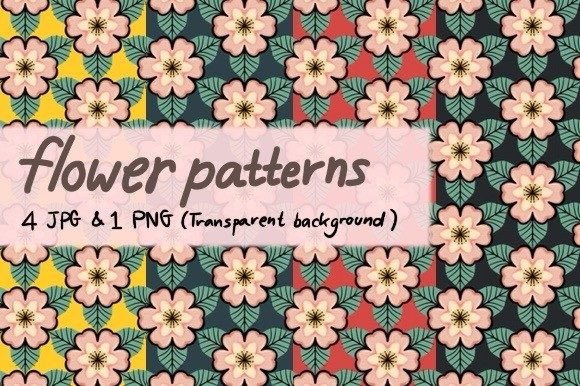
File organization matters too. The package includes four distinct JPGs and one EPS—each representing a unique composition within the volume’s theme. Users report organizing them by density (light/medium/heavy foliage) and motif dominance (bloom-forward vs. leaf-dominant), enabling rapid selection based on layout hierarchy rather than visual scanning. This approach mirrors professional asset management workflows used in agency settings, where speed and consistency outweigh novelty.
Why This Volume Fits Evolving Creative Workflows
Contemporary creative practice increasingly values modularity—the ability to mix, match, and repurpose components across projects. Flower Seamless Patterns Vol.37 aligns with this shift. Its patterns aren’t isolated “decorative fillers”; they’re interoperable units. A designer might extract a single flower cluster from the EPS file and reposition it as a focal icon. An educator could isolate leaf shapes to build a custom alphabet worksheet. A product photographer might overlay a low-opacity version as a texture layer beneath product shots to unify disparate images into a cohesive campaign.
This interoperability extends to accessibility considerations. Because the patterns avoid high-contrast, rapidly repeating geometries (which can trigger visual stress in photosensitive users), they function safely in inclusive digital environments—unlike some geometric or optical-pattern libraries. When used as subtle backgrounds behind text, their organic spacing supports legibility better than tightly packed motifs.
Integration Into Broader Design Systems
For teams building design systems—whether in corporate, academic, or nonprofit settings—Flower Seamless Patterns Vol.37 offers a rare combination: aesthetic cohesion without rigidity. Unlike branded pattern libraries tied to specific colorways or proportions, this volume provides structural variety (curving vines, radial blooms, asymmetric clusters) that can be harmonized through shared typographic treatment, spacing rules, or grayscale conversion. One university communications team adopted it as their “organic accent layer,” applying consistent opacity (12%) and blending modes (Multiply) across all collateral—achieving visual unity without mandating identical assets.
Similarly, small business owners benefit from its plug-and-play utility. A local florist uses one pattern for email headers, another for receipt backgrounds, and a third (recolorized to match seasonal palettes) for Instagram story highlights—all sourced from the same package, eliminating licensing fragmentation and style-guide drift.
Looking Beyond Aesthetics: Long-Term Utility
Patterns endure when they support process, not just appearance. Flower Seamless Patterns Vol.37 demonstrates longevity through its resistance to trend dependency. It avoids hyper-stylized line work or saturated gradients that date quickly. Instead, its strength lies in botanical plausibility—petals follow natural curvature, leaves exhibit believable asymmetry, and negative space respects breathing room. This realism ensures relevance across years, not just seasons.
Moreover, its technical specifications anticipate platform evolution. The EPS 10 compatibility covers legacy workflows (older Illustrator versions still in use across print shops), while the high-res JPGs meet current web performance standards. No proprietary formats, no subscription dependencies—just open, stable, and immediately deployable assets.
In essence, Flower Seamless Patterns Vol.37 functions less like a decorative add-on and more like infrastructure: quietly enabling clarity, consistency, and creativity across disciplines, devices, and delivery methods. Its value emerges not in isolation, but in how seamlessly it integrates—both visually and operationally—into the diverse, demanding, and ever-shifting landscape of modern making.