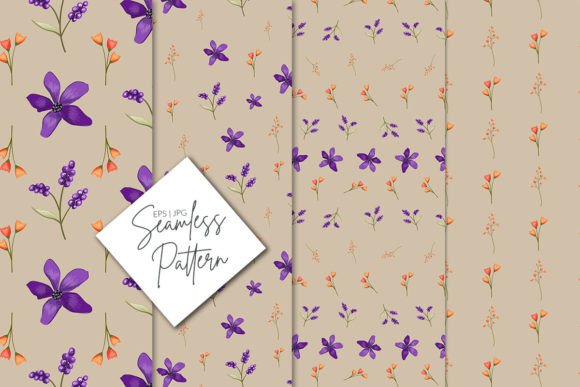
Hand Drawn Rose Flower Seamless Patterns
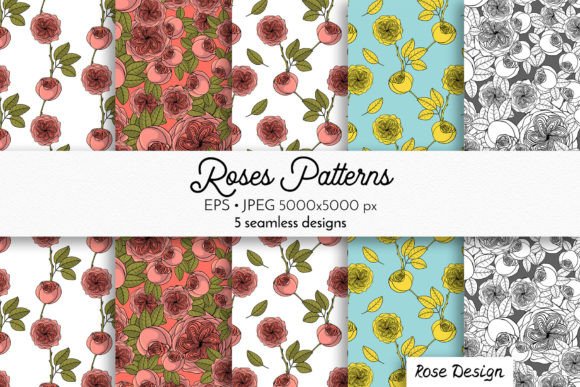
Hand Drawn Rose Flower Seamless Patterns is a curated digital design resource consisting of five original, repeatable floral patterns featuring Juliet roses—rendered in both hand-drawn line art and soft color variations. Each pattern is designed to tile seamlessly, meaning it can be repeated horizontally and vertically without visible breaks or misalignments. The set includes high-resolution raster files (JPG, 5000×5000 px) and scalable vector files (EPS10), supporting diverse production needs from print to textile.
Who Might Consider This Set—and Why
Designers, crafters, small-batch makers, and hobbyists often seek seamless patterns for projects requiring consistent, repeatable surface decoration. Hand Drawn Rose Flower Seamless Patterns may appeal to those who value organic texture and botanical authenticity over geometric precision or photorealism. The Juliet rose—a cultivar known for its rosette shape, lush petal layers, and soft pink-to-cream hues—serves as the central motif, lending warmth and subtle elegance.
Interest typically arises when users need versatile, ready-to-use assets that balance artistic character with technical reliability. For example, someone designing greeting cards might prioritize clean line art for easy coloring or foil stamping; a textile designer may prefer the full-color versions for fabric sampling; a stationery brand owner may evaluate whether the black-and-white variants suit letterpress workflows.
Practical Benefits and Realistic Expectations
The inclusion of both JPG and EPS10 files offers flexibility across software ecosystems and output methods. JPGs provide immediate usability in photo editors and layout tools, while EPS vectors allow infinite scaling without quality loss—ideal for large-format printing or embroidery digitizing. At 5000×5000 px, the raster files support high-DPI print applications up to approximately 16.7 inches square at 300 DPI, suitable for most commercial printing standards.
However, users should note that “hand drawn” implies intentional imperfection: slight line weight variation, subtle tapering, and gentle irregularities in petal placement. These qualities enhance visual charm but may not suit contexts demanding strict symmetry or machine-perfect uniformity—such as certain industrial wallpaper specifications or laser-cut stencil designs where precise edge registration matters.
Also, while the patterns are seamless, their density and scale are fixed per file. Adjusting repeat size requires manual editing in vector software or resampling in raster editors—neither of which is automated or included in the set. Users expecting built-in resizing tools or AI-assisted adaptation will need to supplement with external software or services.
Situations Where This Set Is a Strong Fit
This collection works well when the goal is to introduce artisanal warmth into physical products. It suits small-run printed goods like gift wrap, handmade cards, or limited-edition notebooks—where uniqueness and tactile sensibility matter more than mass-production efficiency. The black-and-white line art versions are especially practical for screen printing on fabric, heat-transfer vinyl cutting, or watercolor-style digital overlays.
Textile designers evaluating options for cotton voile, linen, or quilting cotton may find the moderate scale and open spacing of these patterns conducive to drape and breathability. Similarly, interior designers sourcing custom pillow covers or upholstery swatches can preview how the rose motifs integrate with existing palettes—particularly since the color variants avoid oversaturation, allowing them to recede or complement rather than dominate.
Educators or students exploring pattern structure may also benefit: the clear line art makes it easier to study motif arrangement, repeat types (e.g., half-drop vs. brick), and negative space usage—offering concrete examples for foundational surface design coursework.
When Alternatives May Be Worth Exploring
If your project demands exact control over color separation—for instance, for spot-color screen printing with four or fewer inks—the provided JPGs and EPS files would require manual conversion and trapping. In such cases, a pattern set delivered in layered, Pantone-indexed AI or PDF files may offer greater workflow efficiency.
Similarly, users needing adaptive sizing—like generating multiple repeat scales from one source file—or requiring SVG or PNG transparency for web-based mockups may find the EPS10 format less immediately compatible than modern web-optimized formats. While EPS remains widely supported, some newer design platforms prioritize SVG or multi-layer PSD structures.
For strictly monochrome applications—such as engraving on metal or wood—vector line art is appropriate, but users should verify stroke consistency and minimum line thickness in their target output medium. The hand-drawn nature means some strokes taper near endpoints; depending on the fabrication method, those areas may not render reliably below ~0.25 pt at final scale.
Making an Informed Decision
To determine whether Hand Drawn Rose Flower Seamless Patterns aligns with your goals, begin by clarifying your primary use case and constraints:
- Output method: Will you print digitally, screen-print, embroider, or cut vinyl? Match file type (JPG vs. EPS) and resolution requirements accordingly.
- Scale needs: Do you require one standard repeat size, or must the pattern adapt across multiple dimensions? If the latter, assess whether your software supports non-destructive tiling adjustments.
- Aesthetic priority: Does your brand or project emphasize natural texture and variation—or crisp, repeatable geometry? The hand-drawn quality is a feature, not a limitation—but only if it matches your visual language.
- Technical capacity: Are you comfortable opening and modifying EPS files in Adobe Illustrator or Affinity Designer? If not, confirm whether the JPG versions meet your resolution and color-mode (CMYK vs. RGB) needs before purchase.
Finally, consider sample testing: apply one pattern to a small physical prototype—such as a printed card or fabric swatch—to evaluate contrast, legibility, and tonal balance under real lighting and viewing conditions. What reads clearly on screen may shift in print due to ink absorption, paper texture, or dye behavior.
Hand Drawn Rose Flower Seamless Patterns offers a focused, cohesive solution—not a universal toolkit. Its strength lies in intentionality: five thoughtfully composed iterations of a single botanical subject, built for tangible outcomes. When matched to compatible workflows and aesthetic goals, it provides reliable, expressive utility without unnecessary complexity.