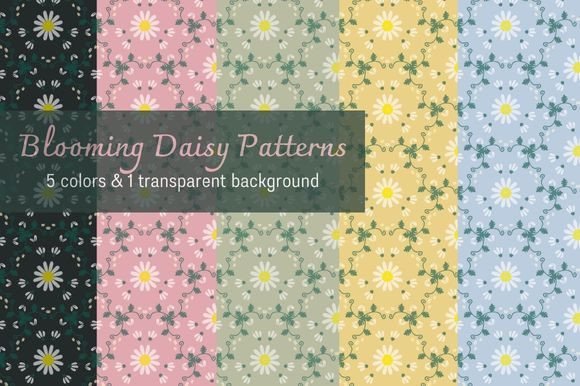
Blooming Daisy Patterns: Your Go-To Resource for Versatile, Print-Ready Floral Design
Whether you’re designing a wedding invitation at midnight, prepping fabric swatches for a small-batch clothing line, or building a soft, nature-inspired background for your client’s wellness blog—Blooming Daisy Patterns delivers consistent, high-fidelity floral motifs that just work. No clipping masks needed. No chasing transparency fixes. Just five rich JPGs and one crisp PNG with transparent background—all sized to 4,095 × 4,095 pixels and rendered at true 300 DPI—ready to drop into any project, physical or digital.
Real Projects, Real Time Savings
Here’s what makes Blooming Daisy Patterns feel less like a download and more like a creative teammate:
- Invitations & stationery: Print wedding, baby shower, or birthday invites on premium cardstock—no pixelation, no scaling stress. Because the files are square and resolution-locked at 300 DPI, they hold up beautifully whether you're printing at home on an Epson or sending to a commercial printer in Chicago.
- Web & UI design: That subtle daisy repeat? Use the PNG as a CSS background-image for a landing page hero section—or layer it softly behind text blocks in Figma or Adobe XD. Its clean transparency means zero extra masking, and the generous canvas gives you room to crop, rotate, or fade without losing fidelity.
- Scrapbooking & mixed media: Physical crafters love that each file is large enough to print full-page layouts (think 12×12 scrapbook pages) *and* small enough to cut out individual blossoms with precision scissors or a Cricut. The consistent color palette across all five JPGs means your layout stays cohesive—even if you mix and match patterns mid-project.
- Print-on-demand (POD) & fabric design: Upload straight to Spoonflower, Redbubble, or Printful. The 4,095 × 4,095 size aligns cleanly with common POD tile requirements—and because the patterns are seamless by design (not just labeled “seamless”), you avoid awkward repeats or misaligned stems when tiled across tote bags, pillow covers, or organic cotton tees.
- Wallpaper & interior visuals: Interior designers use one of the JPGs as a mood board texture in Photoshop, then scale it to mock up accent walls or custom wallpaper panels. The resolution ensures sharpness even when enlarged across a 16-foot wall visualization.
Who’s Already Using These Patterns—and Why It Fits Their Workflow
A freelance graphic designer in Portland uses the transparent PNG to build branded email headers for her florist clients—dropping the daisy motif behind minimal typography, adjusting opacity to 15% for elegance. A homeschooling parent in Ohio prints two of the JPGs on sticker paper, cuts them into mini daisies, and uses them to label sensory bins and reading logs. A textile artist in Asheville layers the patterns in Procreate, recolors stems using HSB sliders, then exports for hand-screened linen napkins.
What ties these users together isn’t their tools—it’s their need for certainty. With Blooming Daisy Patterns, there’s no guessing whether the file will blur when scaled, no hunting for matching vectors, no worrying about licensing restrictions for commercial use. You get what’s described—nothing hidden, nothing upsold.
Practical Considerations Before You Begin
While Blooming Daisy Patterns is built for ease, a few real-world notes help you make the most of it:
- Color consistency matters: The files use sRGB color space—ideal for screen use and most consumer printers. If you’re preparing for professional offset printing (e.g., luxury greeting cards), consider soft-proofing in Photoshop using your printer’s ICC profile. The daisy tones are warm but neutral enough to shift gracefully across CMYK workflows.
- Tile behavior varies by editor: In Canva or PowerPoint, you may need to manually duplicate and align for seamless tiling—but in Affinity Designer or Illustrator, enabling “Pattern Fill” with the JPG often auto-repeats cleanly thanks to the balanced motif spacing. The included PNG won’t tile automatically (it’s a single motif), but its transparency makes it perfect for overlay accents.
- Physical scale is predictable: At 300 DPI and 4,095 pixels wide, each file prints at exactly 13.65 inches square—ideal for standard poster frames, large-format scrapbook layouts, or half-yard fabric swatches. Need smaller repeats? Resize in your editor *before* tiling—don’t rely on software auto-resample during export.
- No fonts or layered PSDs included: This is intentional. Blooming Daisy Patterns focuses on the core asset—the pattern itself—so it stays lightweight, universally compatible, and fast to load in older machines or tablet-based editors like Concepts or Tayasui Sketches.
Strengths That Show Up Where It Counts
What users consistently notice isn’t just quality—it’s how little friction there is between idea and output. The daisy motifs avoid overly intricate linework, so they reproduce well on textured paper or low-ink settings. The spacing between blooms leaves breathing room for text overlays or photo cropping. And because all five JPGs share the same base palette (creamy whites, sage greens, soft buttery yellows), mixing them feels intuitive—not chaotic.
It’s also refreshingly format-agnostic. Whether you paste the PNG into Google Slides for a workshop handout, drag the JPG into DaVinci Resolve for a lower-third background, or import it into Cricut Design Space as a print-then-cut image—the files behave as expected. No corrupted layers. No missing alpha channels. No “please update your software” warnings.
Where It Might Not Be the Perfect Fit
Blooming Daisy Patterns shines in applications where warmth, approachability, and botanical softness matter—but it’s not designed for ultra-minimalist monochrome branding, industrial tech interfaces, or high-contrast accessibility-first layouts. If your project requires bold geometric contrast or strict WCAG-compliant foreground/background ratios, you’ll want to pair these patterns thoughtfully—perhaps as subtle textures beneath clear typography rather than primary visual drivers.
Also worth noting: while the motifs are original and hand-crafted, they lean into classic daisy structure—not abstract or avant-garde interpretations. So if you’re sourcing for a punk zine or cyberpunk game UI, these may feel too gentle. But for garden centers, yoga studios, boutique bakeries, pediatric clinics, or handmade soap labels? They land with quiet confidence.
More Than Just Files—A Creative Anchor Point
When you open the download folder and see those six files—clean, consistent, quietly joyful—you’re not just getting assets. You’re getting permission to move faster, trust your instincts, and keep the focus where it belongs: on your message, your craft, your people. Blooming Daisy Patterns doesn’t ask you to learn a new tool or adapt your process. It meets you where you are—in Canva, in Illustrator, in your kitchen craft corner, or in your Shopify theme editor—and adds just enough floral calm to make the next step feel lighter.