Animal Patterns – an Eclectic Collection
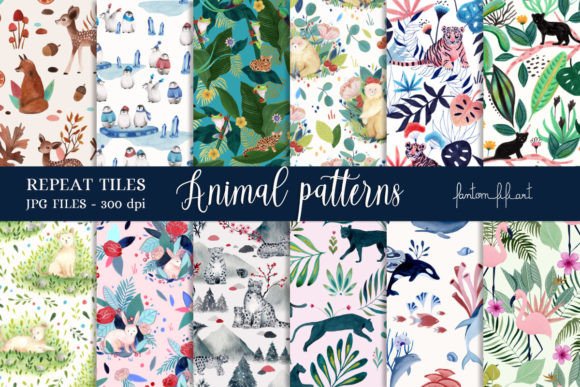
Animal Patterns – an Eclectic Collection is a curated set of 20 hand-painted, digitally refined seamless repeat patterns designed for creative professionals and hobbyists alike. Each motif was originally created using traditional media—watercolor, gouache, and colored pencils—then carefully digitized to preserve texture, nuance, and organic charm. The result is a cohesive yet varied visual library that balances artistic authenticity with practical usability.
What sets this collection apart from other animal-themed pattern resources
Many digital pattern libraries rely on vector-based or AI-generated assets, prioritizing scalability and uniformity over tactile character. Animal Patterns – an Eclectic Collection distinguishes itself through its analog foundation: visible brushstrokes, subtle pigment granulation, soft pencil lines, and gentle color transitions that resist the clinical precision of purely digital work. This gives the patterns warmth and personality—qualities especially valuable in contexts where emotional resonance matters, such as children’s stationery, boutique packaging, or handmade greeting cards.
Unlike pattern packs built around a single species or rigid theme (e.g., “only foxes” or “strictly jungle animals”), this collection embraces eclecticism: you’ll find stylized hedgehogs alongside abstracted flamingos, curious owls interwoven with playful squirrels, and minimalist badgers sharing space with expressive rabbits. The diversity isn’t random—it reflects intentional curation for visual harmony across contrast, scale, and rhythm. That makes it easier to mix and match within a single project without clashing tonally or stylistically.
Practical specifications and real-world usability
All 20 patterns are delivered as high-resolution JPG files—300 dpi, minimum 2000 × 2000 pixels—making them suitable for both screen-based design and professional print applications. Because they’re seamless repeats, they tile cleanly across surfaces without visible seams, supporting everything from fabric yardage to notebook covers to large-format wall decals.
Notably, the files arrive watermark-free—a small but meaningful detail when evaluating value. Some designers avoid watermarked assets entirely due to licensing uncertainty or extra post-processing time; here, there’s no need to crop, mask, or re-export before use. That said, users should be aware that color fidelity depends on display calibration. As with any screen-based preview, printed output may vary slightly—particularly with watercolor’s delicate washes and gouache’s matte opacity. For critical color-matching (e.g., brand-aligned fabric runs), test printing a small swatch is advisable.
Where this collection fits among alternatives
When comparing pattern resources, three broad categories emerge: hand-drawn analog collections (like Animal Patterns – an Eclectic Collection), scalable vector-based libraries, and generative or AI-assisted pattern tools.
- Vector-based pattern sets excel in flexibility—you can recolor, resize infinitely, or isolate individual elements—but often lack the grain, bleed, and imperfection that give hand-painted work its appeal. They’re ideal for branding systems needing strict consistency, but less suited for projects aiming for artisanal warmth.
- AI-generated pattern tools offer speed and near-instant customization, letting users describe motifs and generate variations on demand. However, they rarely replicate the intentionality behind layered watercolor glazes or the deliberate restraint of a pencil outline. Output tends toward repetition or abstraction unless heavily guided—and even then, fine-tuning often requires manual refinement.
- Hand-painted collections like Animal Patterns – an Eclectic Collection occupy a middle ground: they provide the authenticity of physical media without the scanning, cleanup, and tiling labor involved in creating originals from scratch. You get the expressive quality of analog art, packaged for immediate integration into digital workflows.
Best-fit use cases—and when to consider another option
This collection shines in applications where aesthetic cohesion and approachability matter more than infinite scalability or pixel-perfect editing. Think:
- Independent stationery designers developing themed card suites or printable planners
- Small-batch fabric printers producing limited-run scarves, tote bags, or quilting cottons
- Educators and craft facilitators preparing kids’ activity sheets, coloring pages, or classroom décor
- Self-publishing authors illustrating chapter headers or cover details for nature-themed children’s books
In these scenarios, the organic textures and friendly animal motifs help establish tone quickly—no need to layer effects or simulate hand-drawn qualities artificially. The variety also supports iterative exploration: one designer might build an entire product line around the owl-and-mushroom repeat, while another combines the hedgehog motif with the leafy squirrel background for layered textile designs.
That said, Animal Patterns – an Eclectic Collection isn’t optimized for every need. If your workflow demands editable layers (e.g., isolating a fox outline to recolor separately), vector source files would be more appropriate—even if they require additional art direction to achieve similar warmth. Similarly, if you’re designing for responsive web interfaces where patterns must scale fluidly across devices, SVG-based tiling may offer more control than fixed-resolution JPGs.
Decision factors to weigh before choosing
Consider these practical questions when evaluating whether Animal Patterns – an Eclectic Collection aligns with your goals:
- What’s your primary medium? If most output is print-based—especially on natural fibers or textured papers—the softness of watercolor translates well. For heavy UI or app design, crisp vectors may integrate more predictably.
- How much time do you have for asset preparation? These files are ready to drop into Photoshop, Illustrator (via placement), or Procreate—no tracing, cleaning, or tiling setup required. That saves hours versus starting from scanned sketches.
- Do you need thematic expansion later? While the collection includes 20 distinct patterns, it doesn’t include alternate colorways, isolated motifs, or companion illustrations. If future flexibility matters (e.g., swapping a blue fox for a rust one mid-project), check whether the seller offers add-ons—or whether you’re comfortable adjusting hues manually.
- Is consistency across projects essential? Because each pattern was painted individually, there’s slight variation in line weight and saturation. That enhances charm but means absolute uniformity across all 20 isn’t the goal. If brand guidelines require identical stroke thickness or hue values across every motif, a vector suite may better serve that requirement.
A balanced perspective for informed choices
Animal Patterns – an Eclectic Collection isn’t a universal solution—but it’s a thoughtful one. Its strength lies in bridging intention and utility: the care evident in each brushstroke supports creative storytelling, while the technical execution ensures reliability in production. It suits makers who value material honesty in their visuals and prioritize ease of use without sacrificing character.
Ultimately, the right pattern resource depends less on objective superiority and more on alignment with your process, audience, and output requirements. If you’re weighing options, look beyond file count or resolution numbers. Ask instead: does this support how I work? Does it reflect the feeling I want to convey? And does it leave room—for me—to focus on what matters most: the idea, the craft, the connection.