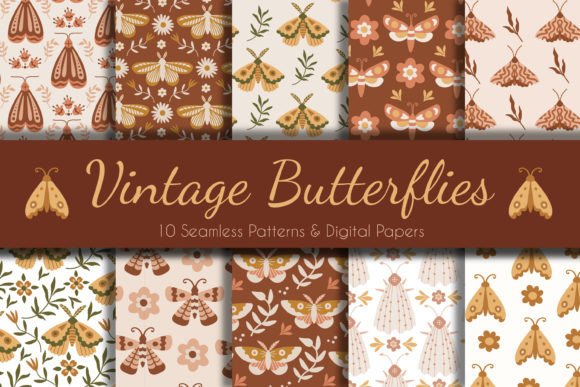
Vintage Butterflies Patterns Papers
If you're designing greeting cards, packaging, or textile prints—and want that effortlessly elegant, quietly nostalgic charm—Vintage Butterflies Patterns Papers delivers exactly what modern creators need: ten cohesive, high-resolution digital patterns rooted in nature and refined by time. These aren’t just “vintage-style” graphics slapped together. They’re thoughtfully composed seamless repeats with botanical authenticity, soft tonal harmony, and subtle textural nuance—designed to elevate real projects without demanding extra design labor.
Nature-Inspired Details, Thoughtfully Curated
Each of the ten patterns features hand-drawn (or hand-styled) butterflies, moths, daisies, chamomile, tulips, delicate twigs, and feathery leaves—all arranged with organic rhythm rather than rigid symmetry. The color palettes lean into muted earth tones: dusty sage, faded rose, oatmeal beige, slate blue, and warm taupe—colors that feel both timeless and refreshingly current in today’s boho, cottagecore, and slow-living aesthetics.
What sets these apart from generic “vintage floral” packs is their intentional restraint. There’s no visual noise—no over-saturated blooms or chaotic layering. Instead, elements breathe within generous negative space, making them ideal for applications where clarity and elegance matter: business stationery, fabric yardage, or minimalist book covers.
Practical Formats, Real-World Flexibility
You receive each pattern in three widely compatible formats: PNG (with transparent background for easy layering), JPG (optimized for print and web use), and EPS (vector-based, fully scalable for signage, embroidery digitizing, or large-format printing). All files are 3600 × 3600 pixels at 300 dpi—meaning crisp output whether you’re printing a 12×12 scrapbook page or scaling up to a 48-inch wallpaper panel.
No clipping masks required. No tedious tiling workarounds. Each file is truly seamless—tested across multiple tile repetitions—so your printed wrapping paper flows smoothly, your fabric repeat looks professionally manufactured, and your website background stays visually cohesive at any viewport width.
Where These Patterns Shine—Beyond the Obvious
Yes, they’re perfect for greeting cards and gift wrap—that’s obvious. But their quiet versatility becomes most valuable in less predictable places:
- Small-batch product packaging: A ceramic studio uses one pattern as a matte-finish label background for herbal tea tins—soft colors reinforce natural ingredients; butterflies subtly suggest transformation and care.
- Educational materials: A Montessori teacher prints butterfly-and-flower patterns onto laminated sorting cards—muted tones reduce visual fatigue for young learners while reinforcing botany themes.
- Website UI accents: A wellness coach overlays a low-opacity version of a twig-and-moth pattern behind testimonial sections—adding texture without competing with text, reinforcing brand warmth and groundedness.
- Textile prototyping: A fashion student samples two patterns on cotton voile before committing to full-yard dyeing—testing how motifs scale and interact with fabric drape and stitch density.
This kind of adaptability isn’t accidental. It comes from designing *for use*, not just appearance—anticipating how light interacts with matte paper stock, how vector paths behave when resized for embroidery software, or how a PNG’s transparency holds up against gradient backgrounds in Canva or Figma.
Smart Integration Tips for Professionals & Hobbyists Alike
Before dropping a pattern into your next project, consider these practical notes:
- Test contrast early: Muted palettes can fade into light-colored substrates. Try overlaying a 5–10% black tint or adding a faint drop shadow to key elements if printing on ivory cardstock or off-white fabric.
- Respect scale context: A pattern that reads beautifully on a 5×7 invitation may overwhelm a 2×3.5 business card. Use your design software’s pattern scale tool—not zoom—to adjust motif size proportionally.
- Leverage EPS intelligently: Open the EPS files in Illustrator or Affinity Designer to recolor individual elements (e.g., shift all butterflies to gold foil tone while keeping stems olive). This maintains cohesion while customizing for seasonal campaigns or brand variants.
- Check licensing scope: These files support commercial use—including client work and physical product resale—but always verify permitted usage for your specific platform (e.g., some POD services require extended licenses for certain categories like apparel).
Why Designers Return to This Collection Again and Again
It’s not just about aesthetics. It’s about efficiency with integrity. You don’t sacrifice originality to save time. You don’t default to overused stock motifs because you’re racing a deadline. With Vintage Butterflies Patterns Papers, you get design authority baked in—the kind that reassures clients, resonates with audiences, and feels authentic to your voice.
A freelance stationer told us she uses one pattern as her signature lining for custom wedding boxes—clients consistently mention how “calm” and “intentional” it feels compared to busier alternatives. A boutique skincare brand layered another across their Instagram Story templates, using the moth motif as a subtle animated transition between product shots—creating continuity without repetition.
That’s the quiet power here: patterns that support storytelling instead of interrupting it.
A Final Note on Authenticity
True vintage inspiration isn’t about replicating aged paper textures or adding arbitrary grain. It’s about honoring how nature was rendered in quieter eras—carefully observed, gently stylized, respectfully composed. These patterns reflect that ethos. They won’t shout. But they’ll hold attention. They won’t trend-hop. But they’ll stay relevant across seasons, launches, and rebrands.
Whether you're hand-lettering a birth announcement, sourcing fabric for a capsule clothing line, or building a Shopify store for handmade candles, Vintage Butterflies Patterns Papers gives you a foundation that feels both personal and polished—without needing to start from scratch.