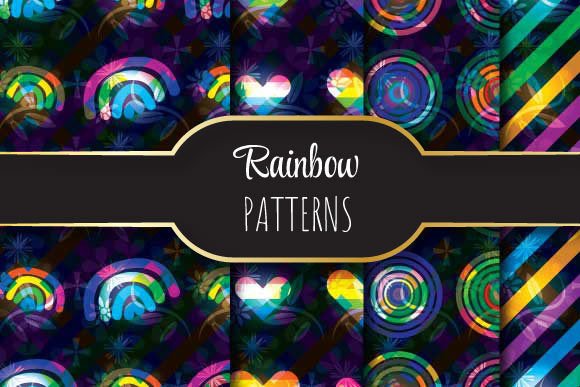
Rainbow Patterns: Seamless Vector Designs for Professional Print and Digital Use
Rainbow Patterns refer to a curated collection of vector-based, seamlessly repeating designs that emphasize vibrant, harmonious color transitions across the visible spectrum. Unlike generic gradient overlays or isolated clipart motifs, these patterns are built as true tessellations—each tile edge aligns precisely with its neighbors, enabling infinite tiling without visible seams or distortion. The set is delivered at a fixed, production-ready resolution: 12 × 12 inches (3600 × 3600 pixels) at 300 dpi—ideal for high-fidelity print applications such as packaging, stationery, fabric printing, or large-format wall graphics.
What Makes Rainbow Patterns Distinct in Practice
The defining characteristic lies not just in color but in construction. Each pattern is authored in Adobe Illustrator EPS 10 format—a widely supported, editable vector standard that preserves scalability, layer integrity, and transparency. This means designers can recolor individual elements, adjust spacing, or isolate components without raster degradation. The inclusion of four JPEG variants (RGB, CMYK, grayscale, and sRGB-optimized) adds flexibility for quick previews, web mockups, or prepress checks—without requiring vector editing software.
Unlike algorithmically generated “rainbow” textures found in some design marketplaces, Rainbow Patterns are hand-crafted with deliberate rhythm and balance. Motifs avoid visual noise by limiting simultaneous hue saturation—no more than three dominant chromatic families appear in any single repeat unit. That restraint supports legibility when overlaid with text or photography, and improves accessibility for viewers with color vision differences.
How Rainbow Patterns Compare With Other Pattern Types
When evaluating seamless pattern resources, users often encounter three broad categories: raster-only tile sets, parametric generative tools, and hand-drawn vector collections. Rainbow Patterns falls squarely in the third group—but with specific tradeoffs worth noting.
- Raster tile sets (e.g., PNG or JPG repeats) offer fast loading and wide compatibility but lack scalability. Enlarging beyond original dimensions introduces pixelation, making them unsuitable for large-format output or logo integration. Rainbow Patterns avoids this entirely through native vector fidelity.
- Parametric generators (such as those embedded in Figma plugins or online pattern builders) provide real-time customization—adjusting scale, spacing, or hue shift on demand. However, they rarely match the typographic precision, intentional negative space, or subtle optical corrections found in hand-authored work like Rainbow Patterns. Generators also produce flat, non-layered output, limiting downstream editing.
- Other vector pattern libraries may prioritize minimalism, monochrome palettes, or geometric austerity. Rainbow Patterns distinguishes itself through chromatic intentionality—not just “colorful,” but structurally calibrated to support both vibrancy and versatility. Its palette transitions follow perceptual color models (CIELAB-based), ensuring smooth luminance curves that hold up under halftone screening or textile dye processes.
Strengths and Real-World Fit
Rainbow Patterns excels where consistency, scalability, and color integrity intersect. Consider these scenarios:
- A branding agency developing a limited-edition product line for an eco-conscious cosmetics brand needs background textures that reflect diversity and natural harmony—without competing with label typography. Rainbow Patterns’ low-contrast repeats allow clean text overlay while reinforcing brand values visually.
- An independent textile designer preparing files for digital fabric printing requires precise 300 dpi alignment and CMYK-safe color definitions. The included JPEG variants let them verify color behavior across RIP software before committing to a full roll of fabric.
- A university communications team designing a series of inclusive event banners seeks accessible, joyful visuals. Rainbow Patterns’ balanced saturation and clear motif hierarchy meet WCAG contrast guidelines when paired with appropriate type weights and sizes—even in large-scale outdoor formats.
Its fixed 12 × 12 inch canvas also simplifies layout workflows. Designers using InDesign or Affinity Publisher can place the EPS directly into master pages, scale uniformly across spreads, and retain crisp edges at any zoom level—no manual tiling or offset calculations required.
Limitations and Situations Where Alternatives May Be Better
Rainbow Patterns is purpose-built—not universal. It does not include SVG versions, so web-first developers needing responsive, code-embedded patterns will need to convert or source elsewhere. Similarly, there are no animated variants, CSS-compatible tile definitions, or variable-font-integrated options. If your workflow relies heavily on motion graphics, interactive interfaces, or dynamic theming, this set serves best as a static asset within a broader toolkit.
The ZIP package contains exactly one EPS file and four JPEG derivatives—no alternate scales, no alternate colorways, no isolated motif files. Users needing modular components (e.g., separate leaf, wave, or dot elements for custom assembly) will find less flexibility here than in some multi-file vector kits. Likewise, those working exclusively in open-source tools like Inkscape should verify EPS 10 compatibility—while most modern versions handle it well, legacy setups may require conversion via command-line tools like inkscape --export-type=pdf.
And while the color transitions are perceptually refined, they are not Pantone-referenced or spot-color separated. For luxury packaging requiring precise metallic inks or brand-specific PMS matches, additional color mapping or separation work remains necessary.
Decision Factors: When to Choose Rainbow Patterns
Ask yourself these practical questions before selecting Rainbow Patterns:
- Is final output primarily physical? If you’re printing business cards, gift wrap, apparel, or signage—and need predictable, scalable, press-ready assets—Rainbow Patterns’ EPS + 300 dpi JPEG combination delivers reliable results.
- Do you value editability over automation? If you prefer adjusting stroke weight, repositioning elements, or adapting motifs to match existing logos or icons, vector-native construction gives you direct control—not just sliders and presets.
- Is color harmony a functional requirement—not just aesthetic? When supporting accessibility, conveying emotional tone, or aligning with seasonal campaigns, the thoughtfully sequenced hues in Rainbow Patterns behave more predictably across devices and substrates than randomly sampled gradients.
- Do you need immediate usability without setup time? With no subscription, no login, and no plugin dependencies, Rainbow Patterns works out of the ZIP folder—ideal for freelancers juggling multiple clients or educators preparing classroom materials on tight deadlines.
Final Considerations for Informed Evaluation
Rainbow Patterns occupies a thoughtful middle ground: more intentional than auto-generated tiles, more accessible than bespoke illustration commissions, and more production-ready than raw AI outputs. It doesn’t replace a color consultant, a textile engineer, or a motion designer—but it reliably fulfills a specific, recurring need: beautiful, seamless, color-rich vector patterns that hold up under scrutiny and scale.
For users comparing resources, the key isn’t whether Rainbow Patterns is “the best,” but whether its constraints align with your project’s delivery requirements, technical stack, and creative goals. A wedding invitation designer may choose it for foil-stamped envelopes; a UI team building a dashboard might pass in favor of lightweight SVG alternatives. Neither choice is wrong—the distinction lies in fit, not superiority.
If your work involves print production, brand consistency across physical touchpoints, or collaborative design environments where file stability matters, Rainbow Patterns offers tangible advantages in reliability, clarity, and chromatic coherence. And because it arrives as a self-contained ZIP—no cloud sync, no license keys, no usage analytics—you retain full ownership and control from first use onward.