Mustard Illustrated Floral Patterns: A Practical Guide for Designers and Crafters
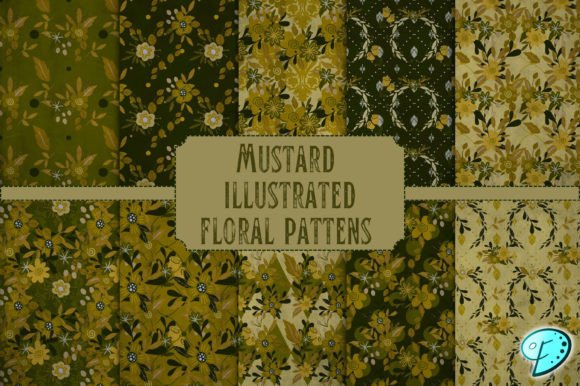
Mustard Illustrated Floral Patterns refers to a curated collection of high-resolution, hand-drawn floral motifs rendered in warm, earthy mustard tones—distinct from generic digital florals or saturated stock graphics. These aren’t algorithmically generated or AI-synthesized; they’re illustrated with deliberate line weight, organic texture, and botanical nuance, then digitally refined for precision. The set comprises 10 unique patterns, each delivered as a 300 DPI JPEG file at exactly 12 x 12 inches—a size optimized for print-on-demand applications, fabric sampling, wallpaper mockups, and craft-scale projects like scrapbooking or decoupage.
What Sets Mustard Illustrated Floral Patterns Apart
The mustard palette is more than aesthetic—it’s functional. Unlike bright yellows or neon tones, mustard sits comfortably between ochre and burnt sienna, offering strong contrast against both light and dark backgrounds without visual fatigue. This makes the patterns especially effective for branding aimed at wellness, artisanal food, heritage textiles, or sustainable home goods. Each of the 10 designs balances repetition and variation: some feature tight, rhythmic vines; others use asymmetrical clusters with intentional negative space. None rely on photorealism or hyper-detail—instead, they prioritize clarity at scale, legibility when scaled down to 4 inches (e.g., on greeting cards), and adaptability when recolored in design software.
Because they’re supplied as JPEGs—not vectors or layered PSDs—they’re immediately usable across platforms that don’t support advanced file types. That includes basic embroidery software, Cricut Design Space, Canva, and even older versions of Adobe Photoshop or Affinity Photo. There’s no learning curve tied to layers, masks, or color modes: open, place, and adjust opacity or blending mode as needed.
How It Compares to Other Floral Pattern Resources
Many designers encounter three common alternatives: royalty-free stock pattern libraries, vector-based floral bundles, and custom illustration commissions. Mustard Illustrated Floral Patterns occupies a specific middle ground—more intentional than stock, more accessible than bespoke work, and more tactile than scalable vectors.
- Stock pattern libraries often include hundreds of motifs, but their floral offerings tend toward generic symmetry, flat color fills, and inconsistent line quality. They’re cost-effective for volume, but lack cohesion if you need a unified look across multiple products. Mustard Illustrated Floral Patterns trades breadth for consistency: all 10 share the same ink-handling style, spacing logic, and tonal range—making them easier to mix within a single brand system.
- Vector floral bundles excel in scalability and recoloring, but can feel overly crisp or mechanical unless carefully designed. Their paths sometimes produce unintended artifacts when rasterized at lower resolutions or printed on textured paper. Mustard Illustrated Floral Patterns avoids this by delivering final raster files—ensuring what you see on screen matches output on matte paper, linen fabric, or ceramic decals.
- Custom illustration commissions offer full creative control but require time, budget, and clear briefs. A single custom floral repeat can take 1–3 weeks and cost several hundred dollars. Mustard Illustrated Floral Patterns delivers production-ready assets instantly, with the added benefit of having been tested across real-world applications—from tote bag prints to wedding stationery—before release.
Realistic Use Cases and Fit
Mustard Illustrated Floral Patterns works best when your goal is speed-to-output without sacrificing visual authenticity. For example:
- A small-batch ceramics studio creating limited-edition mugs uses one pattern as an underglaze transfer—its moderate density ensures clean burnout during firing, unlike ultra-fine linework that blurs at high heat.
- A stationery designer building a wedding suite selects two complementary patterns—one dense vine for envelopes, one airy scatter for vellum overlays—knowing both will align seamlessly in InDesign at 12-inch canvas size.
- An indie apparel brand prototyping a summer dress line tests four patterns on cotton sateen swatches. Because all files are identical in resolution and dimension, side-by-side comparison is objective—not skewed by mismatched scaling or DPI inconsistencies.
It’s less suited for applications requiring extreme enlargement (e.g., billboard-scale murals) or fine-tuned color separation (e.g., screen printing with spot-color inks), since JPEGs don’t preserve CMYK channel data or Pantone references. If your workflow depends on separating floral elements into individual layers—for animation, interactive PDFs, or multi-stage embroidery—you’ll need to manually isolate components using selection tools, which adds time.
Tradeoffs to Consider Before Choosing
No single resource fits every scenario. Here’s what to weigh:
- Format limitations: JPEGs are efficient but inflexible. You can’t easily change individual petal colors without masking. If your project requires dynamic recoloring per SKU (e.g., five shirt colors, each with a different floral tint), vector or layered PNG alternatives may save hours later.
- Palette specificity: While mustard is versatile, it’s not neutral. If your brand palette includes cool teals or stark monochromes, these patterns may require desaturation or luminosity adjustment—steps that slightly soften contrast. Test one file first before licensing the full set.
- Scale fidelity: At 12 x 12 inches and 300 DPI, each file contains over 13 million pixels. That ensures sharpness for most print uses, but may slow performance in browser-based editors or older hardware. If you’re working primarily on tablets or low-RAM laptops, consider whether batch-resizing to 150 DPI (still print-worthy for many craft applications) improves your workflow.
- Licensing scope: These files typically include broad commercial rights—but verify whether sub-licensing (e.g., giving a pattern to a manufacturer who then sells it embedded in their product) is permitted. Some licenses restrict use in digital templates sold on marketplaces like Etsy or Creative Market.
When Mustard Illustrated Floral Patterns Is the Right Choice
Choose this set if you value:
- Visual cohesion over variety: You’re building a single collection—like a capsule home goods line—and want all pieces (pillows, napkins, trays) to feel like part of one thoughtful system.
- Print-first workflows: Your end use is physical—fabric, paper, wood, or ceramic—not web interfaces or animated social content.
- Time-sensitive development: You’re launching in 4–6 weeks and need reliable, tested assets—not exploratory iterations.
- Tactile authenticity: Your audience responds to warmth, craft, and subtle imperfection—not clinical perfection or maximalist density.
Conversely, explore other options if you need SVGs for web use, require Pantone-matched swatches, plan to animate floral elements frame-by-frame, or are developing a long-term brand identity where flexibility across decades matters more than immediate usability.
Making a Confident Decision
Evaluating floral pattern resources isn’t about finding the “best” option—it’s about matching format, tone, and constraints to your actual project conditions. Mustard Illustrated Floral Patterns succeeds where intentionality, print readiness, and tonal harmony matter more than infinite scalability or automated customization. Its strength lies in quiet consistency: ten distinct yet harmonious interpretations of flora, grounded in a color that bridges vintage and contemporary sensibilities.
If you’ve previously worked with floral patterns that felt either too sterile or too chaotic, this set offers a measured alternative—neither minimalist nor ornate, neither mass-produced nor one-off. It assumes you know your audience, understand your materials, and value assets that behave predictably across tools and outputs. That reliability—backed by real-world testing—is what makes it worth evaluating alongside broader, flashier, or more technically flexible alternatives.