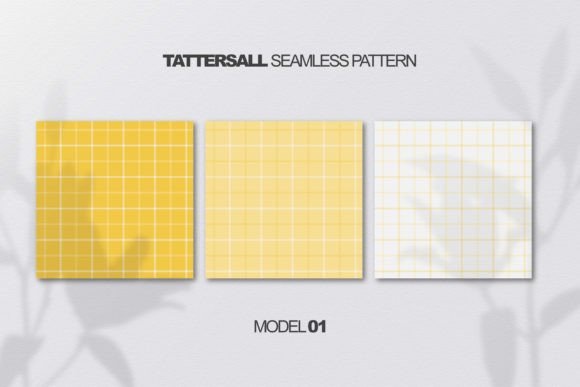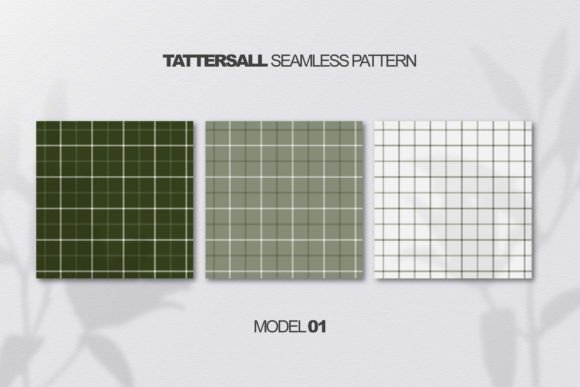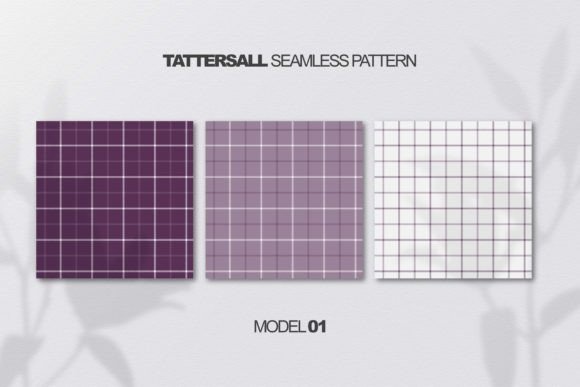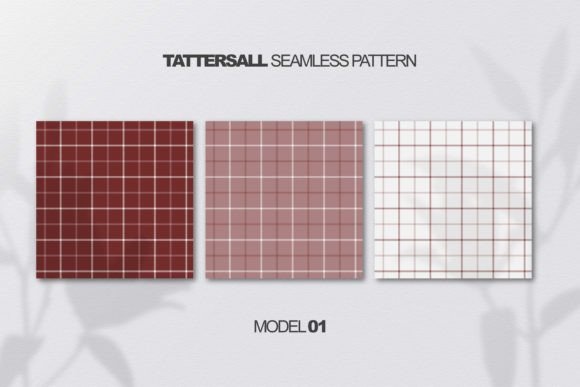
Black Tattersall Seamless Patterns
If you’ve ever spent hours trying to tile a traditional Tattersall check across a large banner, packaging mockup, or fabric swatch—only to spot visible seams, misaligned rows, or pixelated edges—you know how frustrating it is to settle for “good enough.” That’s exactly why Black Tattersall Seamless Patterns exist: not as generic repeats, but as precision-engineered, truly seamless resources built for real-world creative work.
What You’re Actually Getting (and Why It Matters)
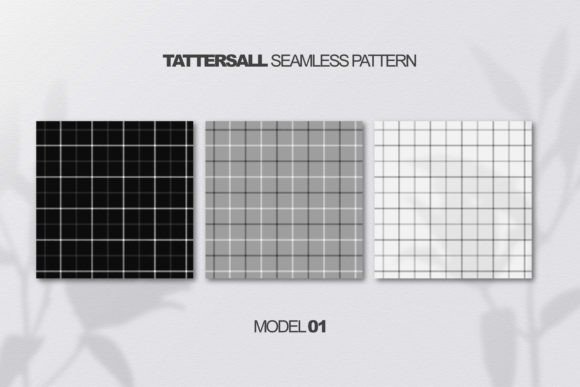
Let’s cut through the ambiguity. This pack includes three distinct Black Tattersall seamless patterns—all delivered in two essential formats:
- 1 EPS file (CC-compatible): Fully editable vector artwork. Every line, angle, and spacing is mathematically precise—no raster artifacts, no resolution limits. Scale from business card size to billboard without losing crispness.
- 3 high-res JPGs (4167 × 4167 px, 150 dpi): Ready-to-use, print-safe rasters—ideal for quick mockups, web previews, or platforms that don’t support vector uploads.
Crucially, all patterns are 100% vector and seamless by design, meaning they repeat infinitely in any direction without gaps, overlaps, or visual hiccups. That’s not just convenient—it’s foundational for professional output.
A Common Misstep: Assuming “Seamless” Means “Plug-and-Play”
Many creators assume that if a pattern says “seamless,” it’ll drop into their project and behave perfectly—no adjustments needed. In reality, seamless doesn’t guarantee compatibility with your workflow. For example:
- Using the JPGs for large-format printing without checking DPI scaling can lead to soft, blurry fills—even at 4167 px, stretching beyond ~12 inches at 300 dpi risks quality loss.
- Importing the EPS into older design software (or non-Adobe tools) may cause clipping or rendering quirks if the vector paths aren’t simplified or saved with backward compatibility in mind.
- Applying the pattern directly to a curved surface (like a 3D bottle mockup) without adjusting the repeat scale can exaggerate distortion—especially with Tattersall’s intersecting lines.
These aren’t flaws in the pattern—they’re mismatches between expectation and execution. The fix? Always test at final output size first. Drop the EPS into your layout at actual scale, zoom to 400%, and pan across tile boundaries. If you see alignment shifts or micro-gaps, adjust your repeat settings—not the pattern itself.
Why “Black” Tattersall Isn’t Just Color—It’s Contrast & Clarity
Tattersall checks are traditionally associated with heritage fabrics—think wool shirts, equestrian gear, or classic tailoring. But when used digitally, the black-on-white (or black-on-transparent) version offers something subtler yet critical: maximum contrast control. Unlike muted or desaturated variants, true black ensures sharp legibility against light backgrounds and predictable behavior in CMYK prepress workflows. It also avoids unintended color casts when overlaid on photos or gradients.
A beginner might choose a gray-based Tattersall thinking it’s “softer” or more versatile—only to discover later that it vanishes against off-white backgrounds or prints inconsistently on uncoated stock. With Black Tattersall Seamless Patterns, you’re choosing reliability over guesswork.
Vector ≠ Automatic Flexibility (Here’s How to Use It Right)
Because these patterns are 100% vector, it’s tempting to assume you can recolor, resize, or distort them freely—and you can—but with caveats. Vector scalability has limits when applied to pattern logic:
- Stretching the EPS disproportionately (e.g., widening horizontally only) breaks the inherent symmetry of the Tattersall grid. The result? Uneven checks that look “off,” even if technically seamless.
- Recoloring via global swatch replacement works cleanly—but using raster-based filters (like Gaussian blur or noise) on the vector layer converts it to pixels, defeating the purpose of having vector source files.
Better approach: Use Illustrator’s Pattern Options panel to adjust spacing, brick offset, or tile size *before* expanding the pattern. Or, recolor using Recolor Artwork—which preserves vector integrity and lets you preview multiple palettes instantly.
What to Verify Before Downloading or Licensing
Before adding Black Tattersall Seamless Patterns to your library—or integrating them into client work—check three things:
- Software Compatibility: Confirm your version of Illustrator (or Affinity Designer, CorelDRAW, etc.) supports the EPS CC format. If you’re on an older OS or cloud-restricted environment, test the JPGs first—they’re universally accessible and still deliver strong results for most digital use cases.
- Intended Output Medium: Are you designing for screen (web, app UI), print (brochures, labels), or physical products (fabric, stationery)? For textiles, ensure your printer accepts vector repeats at full scale; for web, the JPGs often load faster and render more predictably than embedded SVGs.
- Licensing Scope: While this pack is personal and commercial-use friendly, always double-check whether redistribution (e.g., bundling into a template sold on Creative Market) is permitted. Mangata’s note—“If there are any problems or questions… feel free to ask me”—isn’t just polite; it’s an invitation to clarify scope before assuming.
Real-World Use Cases That Benefit Most
This isn’t just wallpaper. Designers and small business owners consistently report strong ROI when applying Black Tattersall Seamless Patterns to:
- Branded Packaging: A subtle black Tattersall background on a kraft box adds texture without competing with logo clarity—especially effective for premium skincare or artisanal food brands.
- Educational Slides & Reports: Using the pattern as a low-opacity overlay on title slides introduces rhythm and structure, helping audiences visually parse dense information.
- Freelance Brand Kits: Clients love receiving vector-based pattern assets they can adapt themselves—no need to hire a designer every time they update social banners or email headers.
In each case, the advantage isn’t just aesthetic—it’s efficiency. One well-chosen, truly seamless pattern eliminates hours of manual tiling, debugging, and revision cycles.
Final Thought: Seamless Is a Starting Point, Not the Finish Line
Having Black Tattersall Seamless Patterns in your toolkit is like owning a well-calibrated ruler: it won’t design for you, but it removes one source of avoidable error. The real value emerges when you pair it with intention—testing at scale, respecting vector logic, matching format to function, and verifying use rights upfront. When you do, what starts as a simple background becomes a consistent, confident element across everything you make.